
Readable loot progression, approachable party building and programmable combat automation.
Game review · updated 2026-09-24
Soda Dungeon 2
A light party-building RPG where scripted dungeon runs turn gear farming into automation.
The short verdict
Approachable combat, visible loot and a campaign give the idle loop concrete goals.
The RPG layer is intentionally breezy rather than build-theory heavy.
- US price
- Free to play
- Offline progress
- partial
- Steam Deck
- playable · Valve classification
- Prestige depth
- Automation depth
- Ending
- Yes
Editorial review
What players love, what breaks the spell and who should actually play it.
A breezy automated dungeon crawler with a real campaign — fun through the credits, much less convincing as an endless grind.
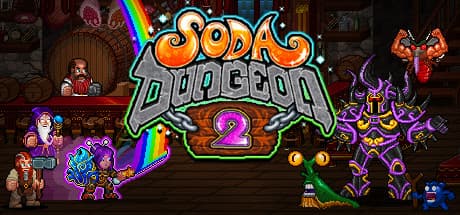
Soda Dungeon 2 gives idle progress faces, gear and a dungeon floor number. Recruit a disposable tavern party, send it into combat, bring home loot and improve the town for the next run. Classes and equipment add enough planning to keep the climb readable, while Soda Scripts let you automate battle behavior instead of merely raising a speed stat. That makes the transition from active RPG to background machine especially satisfying.
The shallowness becomes visible after the main story. Players praise the easygoing loop and automation but frequently describe the late game as an endless item grind where many skills and drops stop mattering. Time away earns Battle Credits to redeem for loot; it does not keep your chosen party fighting through the dungeon after closing the game. The mobile roots and cash shop are visible, even if the campaign is perfectly playable for free. We recommend it as a light, finite-ish idle RPG: enjoy the jokes, solve the party script and finish the story. Treat anything beyond that as optional overtime.
Late-game depth falls away into repetitive farming, with mobile-style monetization always in view.
Players who want an easy idle RPG with concrete dungeon goals and a campaign to clear.
You want serious theorycrafting or expect the post-story grind to keep adding meaningful systems.
93% positiveVery Positive · 3,126 English-language Steam reviews · checked September 24, 2026
Read player reviews on Steam Steam evidence · 12 Oct 2026
What players are saying now.
English reviews, all purchase types. Daily source check; the editorial verdict above has its own review date.
Compare the daily Steam charts →- Positive overall
- 93% of 3,130 reviews
- Last 30 days
- 90%10 reviews · small samples can swing
- New positive reviews
- 1in the last seven days
System analysis
What playing it actually asks of you
See the core loop, the meaningful choices and the kind of session this game rewards.
Core loop
Recruit a party, equip it, send it through a dungeon and convert the recovered gold and items into stronger automated runs.
Progression shape
A campaign and dimension resets create clear milestones, while scripts gradually reduce the need to supervise routine combat.
Does the party keep fighting while closed?
No. The Steam store says time away earns Battle Credits that you redeem for loot after returning. Soda Scripts automate the party's actual dungeon runs while the game is open; closing it does not continue that exact run.
Decision depth
Party composition, equipment and combat scripting offer useful choices without the burden of a highly technical RPG system.
Best session pattern
A good entry point for players who want visible characters, loot and an ending alongside familiar idle progression.
Check the receipts
Steam can change after our last check.
Valve lists this title as Steam Deck Playable; individual compatibility notes may still apply. Price, availability and player sentiment can move, so use the live links before buying.
Continue exploring
Games with overlapping systems
$9.99 · 2021
Melvor Idle
A menu-driven RPG built around RuneScape-like skills, inventories, combat and long offline sessions.
- Offline
- full
- Prestige
- None
- Automation
- Deep
Free · 2022
Farmer Against Potatoes Idle
A dense idle RPG with classes, equipment, challenges and several permanent progression layers.
- Offline
- full
- Prestige
- Very deep
- Automation
- Very deep

Free · 2021
Your Chronicle
A text-forward idle RPG whose routes, summons and layered resets gradually open a larger story.
- Offline
- partial
- Prestige
- Very deep
- Automation
- Deep